

There is a particular kind of irritation that tends to arrive quietly alongside a period. Not the cramping or the fatigue, which get most of the attention, but the rash on the inner thighs. The persistent itch. The redness that appears where the pad sits and lingers for days after the bleeding has stopped. If you have sensitive skin, menstruation brings a second layer of discomfort that rarely gets discussed honestly. The assumption is often that this is just what periods feel like, but it does not have to be. Rash-free period underwear exists precisely because this experience is common enough to design around.
Skin irritation during menstruation has more than one cause, and untangling them matters if you are trying to make a real change in your routine.
Why Menstruation Affects Sensitive Skin
Your skin does not exist in isolation from the rest of your body's hormonal activity. During the menstrual phase, both oestrogen and progesterone drop to their lowest levels. This hormonal dip can leave skin feeling dry and more sensitive, and the inflammatory prostaglandins released during this phase can further heighten skin reactivity.
The drop in oestrogen specifically reduces collagen production and weakens the skin barrier, making it more prone to irritation. Products or materials that feel perfectly fine at other points in your cycle may suddenly sting, itch, or cause a rash during the premenstrual or menstrual phase. This is part of why breathable period underwear tends to make such a noticeable difference for people who have struggled through multiple cycles of unexplained irritation.
This matters most in the vulvar and inner-thigh regions, where the skin is already thinner and more reactive than skin elsewhere on the body. During menstruation, it becomes even more susceptible to anything that rubs against it or traps heat.
How Conventional Period Products Make It Worse
The most common response to period-related skin irritation is to reach for more products. Extra panty liners for discharge days. Pads with odour-neutralising properties for heavier days. In practice, this often compounds the problem.
Gynaecologists generally advise against wearing panty liners all day, every day, and for good reason. The issue is structural. Most disposable pads and liners have plastic backings that seal in heat and moisture. The surface layers that sit against your skin are often synthetic. The adhesive that keeps a pad in place is frequently unreliable, shifting to one side and bunching, which creates friction exactly where you do not want it. The sealed, airless environment this produces is precisely what aggravates sensitive skin.
The chemical concern is more serious still. Studies testing popular sanitary pad brands sold in India, spanning both mainstream and organic options, have found that all tested positive for phthalates and volatile organic compounds (VOCs). These chemicals are introduced partly to add elasticity and partly to produce the "freshness" effect associated with fragranced products. Research has linked long-term exposure to hormonal disruption and increased cancer risk.
What these findings also make clear is that your vaginal area absorbs substances at a significantly higher rate than regular skin, given that it is a mucous membrane. The skin in that region is thin and highly permeable. If you are already managing a skin condition, this is not a peripheral concern.
What To Look For In Period Products For Sensitive Skin
Choosing the right period product when your skin is reactive comes down to three things: fabric, breathability, and what the product is free from.
Cotton is consistently recommended as the safest material for contact with the vulvar area. It is less likely to trigger an allergic reaction than synthetic fabrics, absorbs moisture, and allows your skin to breathe. Synthetic materials like nylon and spandex do the opposite, trapping heat and moisture and creating conditions where irritation is more likely to take hold.
If your skin is prone to flare-ups, gynaecologists generally recommend underwear that is looser, more breathable, and made from natural fibres. But fabric alone is not the full picture. It is worth asking what a product has been treated with before it reaches you. Has it been tested for harmful dyes? Is it free from PFAS, formaldehyde, and heavy metals? These are not obscure questions. They are the difference between a product that is simply soft and one that is genuinely safe to wear against sensitive skin for hours at a time. For anyone researching breathable period underwear specifically, these certifications are the most reliable thing to look for beyond the fabric label.
Are Rash-Free Period Underwear More Effective Than Pads?
For sensitive skin, the structural difference between rash-free period underwear and disposable pads is significant. A pad sits against your skin with a plastic backing behind it and an adhesive holding it in place, both of which reduce breathability and create friction. An absorbent underwear meant for daily use has its absorbent layers built directly into the garment. There is nothing to attach, nothing to shift, and no plastic layer between your skin and the air.
Research has found that both mainstream and organic pad brands contain harmful compounds, which means switching to an "organic" pad does not resolve the underlying problem for sensitive skin. Switching to a certified, tested textile is a meaningfully different category of choice.
Mahina's Daily Panty Liner Underwear For Sensitive Skin
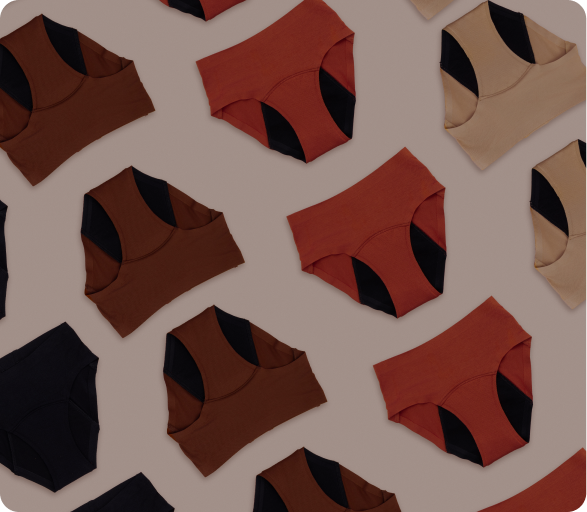
Mahina's Daily Panty Liner Underwear (DPLU) is breathable period underwear for everyday wear. It is designed to manage vaginal discharge, sweat, light leaks, and post-washroom dampness throughout the day, without the adhesive, plastic, or fragrance that conventional liners bring with them.
It works through a built-in multi-layer absorbent gusset that pulls moisture away from your skin and holds it within the layers of the underwear. Since the absorbency is part of the garment itself, there is no separate product that sits against your skin. You can simply slip it on and get on with your day.
When it comes to Mahina’s DPLU, this breathable period underwear comes in two options: breathable cotton for those who prefer a natural feel, and ultra-soft MicroModal for those whose skin responds better to a smoother surface. Both are worth knowing about if friction or texture tend to trigger a reaction for you.
As rash-free period underwear goes, what sets the DPLU apart for sensitive skin is not only what it is made of, but what it has been verified to be free from. It is made using OEKO-TEX certified fabrics and is tested for NABL-accredited labs to be free of PFAS, formaldehyde, and heavy metals. It has also been tested for safety after 6 months of real-world use.
What’s more, you don’t have to line up multiple products or worry about coverage, because Mahina’s breathable period underwear comes in 7 sizes designed for real Indian women, so it sits comfortably against the body and stays put. One pair can be worn for 12 hours, which means fewer changes across the day and less time spent disrupting your skin unnecessarily.
For skin that reacts to almost everything during a period, the most useful thing the DPLU does is simply stay out of the way.
A Quieter Kind Of Care
Your skin isn't being dramatic when it reacts during your period. It is responding to a genuinely difficult combination of hormonal sensitivity, prolonged contact with synthetic materials, and chemical exposure that goes unacknowledged on the packaging of common products. Addressing it does not require an elaborate routine. It requires paying attention to what is actually touching your skin for many hours a day, and choosing accordingly. The right period product, for sensitive skin, is one that disappears into the background.
To Sum It Up
Sensitive skin can make menstruation more uncomfortable than usual, with rashes, itching, and redness that persist even after the flow stops. These reactions are often worsened by hormonal fluctuations, thinner vulvar skin, and products that trap heat, moisture, or contain synthetic materials. Conventional pads and liners may shift, bunch, or include chemicals that aggravate irritation, making daily wear stressful. Choosing rash-free, breathable period underwear designed for sensitive skin can significantly reduce discomfort. Key features include proper fit, high-quality fabrics, and certified safety testing to ensure no harmful chemicals come in contact with the skin.

Sources
- Samphire: How Your Menstrual Cycle Affects Your Skin
- Mahina: Daily Panty Liner Underwear
- Healthline: 8 Underwear Rules to Live by for a Healthy Vagina
- Healthshots: Wearing a wet underwear for too long can do this to your vaginal health
About The Author