



Key Takeaways
- A period that is suddenly heavier than usual can happen because of normal cycle variation, changes in contraception, a copper IUD, a cycle without ovulation or certain medicines.
- According to the NHS, periods usually last 2 to 7 days, with bleeding tending to be heaviest during the first 2 days. Around 20 to 90 ml of blood loss over the whole period can fall within the usual range.
- Heavy menstrual bleeding is better recognised by signs such as soaking through protection every 1 to 2 hours, bleeding for more than 7 days, large clots or bleeding that disrupts daily life.
- If pregnancy is possible, unusually heavy bleeding with severe abdominal or pelvic pain, dizziness or faintness needs prompt medical assessment because pregnancy complications can also cause bleeding.
- Tracking your bleeding, symptoms and product use across your next few cycles can help show whether this month was an isolated change or part of a new pattern.
If you're wondering why your period is so heavy this month, start by comparing it with what is normal for you. One heavier cycle does not automatically mean something is wrong, but a sudden change can also happen because of contraception, ovulation changes, medication, pregnancy-related bleeding or an underlying reproductive health condition.
Why Is My Period So Heavy This Month?
Your period may be heavier this month because your menstrual flow can naturally vary, but a sudden change can also be triggered by contraception, ovulation, medication or an underlying condition.
The most useful question is not simply "Is this heavy?" but "Is this significantly heavier than my usual period?" NICE recommends taking natural variation in menstrual cycles and blood loss into account when assessing heavy menstrual bleeding.
How Can You Tell If This Period Is Actually Heavier Than Usual?
Compare this cycle with your normal bleeding pattern, rather than relying on a fixed number of pads or millilitres.
Look at whether:
- You are changing your usual protection much more frequently.
- You are bleeding through clothes or bedding when you normally do not.
- Your period is lasting longer than usual.
- You are passing larger or more frequent clots.
- You suddenly need two forms of protection together.
- The bleeding is affecting work, sleep, exercise or everyday activities.
A change that repeats over several cycles is particularly worth discussing with a doctor.
Is Day 2 Usually The Heaviest Day Of Your Period?
The first 2 days of a period tend to be the heaviest, but there is no rule that day 2 must always be your heaviest day.
The NHS notes that menstrual bleeding generally peaks during the first 2 days and becomes lighter afterwards. Your own pattern may differ, so a heavy second day may be completely normal for you if it follows your usual cycle.
What Is The Difference Between Normal And Abnormal Period Flow?
Normal period flow varies widely, while abnormal bleeding is defined more by a major change in amount, timing, duration or impact on daily life.
|
What To Compare |
Usually Within A Typical Range |
May Suggest Heavy Or Abnormal Bleeding |
|
Duration |
Around 2–7 days |
More than 7 days |
|
Flow |
Varies across the period and is often heaviest early on |
Soaking through a pad or tampon every 1–2 hours |
|
Clots |
Small clots can occur |
Clots larger than about 2.5 cm |
|
Protection |
Changes based on flow and comfort |
Needing two products together or bleeding through clothes/bedding |
|
Daily life |
Manageable alongside normal activity |
Bleeding regularly interferes with work, sleep, exercise or daily life |
|
Timing |
Follows your usual cycle pattern |
Unexpected bleeding between periods or a major new change |
These signs are consistent with NHS guidance on heavy menstrual bleeding.
What Constitutes Normal Period Flow?
A normal period can vary from person to person, but it usually follows a fairly consistent pattern for you.
- Duration: Periods commonly last around 2 to 7 days.
- Flow: Bleeding is often heaviest during the first 2 days and becomes lighter afterwards.
- Volume: The NHS gives an approximate range of 20 to 90 ml across the entire period, although most people do not measure this directly.
- Clots: Small clots can occur, particularly on heavier days.
- Colour: Period blood may range from bright red to dark red or brown as the flow changes.
- Discomfort: Mild to moderate cramps can be normal, but pain should not regularly stop you from doing everyday activities.
The NHS notes that both the amount and pattern of bleeding can vary, so your own usual cycle is an important reference point.
What Are The Signs Of Abnormal Period Flow?
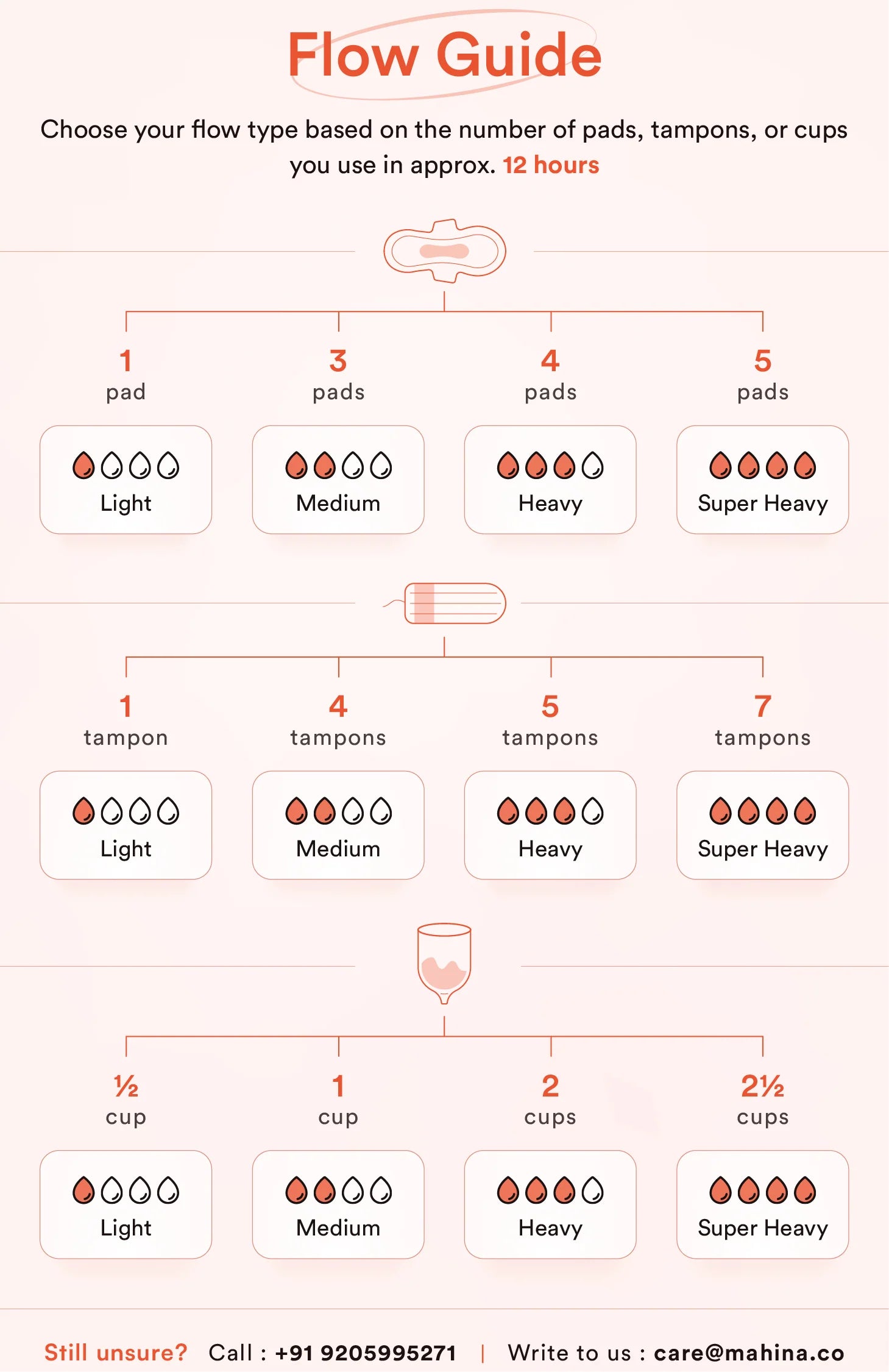
Bleeding may be unusually heavy when you are changing protection very frequently, bleeding for longer than usual or experiencing symptoms from the blood loss.
Watch for:
- Soaking through a pad or tampon every 1 to 2 hours.
- Bleeding for more than 7 days.
- Passing clots larger than around 2.5 cm.
- Bleeding through clothing or bedding.
- Needing two period products together.
- Feeling unusually tired, weak, dizzy or short of breath.
- Heavy bleeding that limits normal activities.
The NHS lists these among the key signs of heavy periods.
What Can Suddenly Make Your Period Heavier This Month?
A one-off heavier period can happen because something changed during this cycle, even if your periods are usually predictable.
A Recently Inserted Copper IUD
A copper IUD can make periods heavier, longer or more painful, particularly during the first few months after insertion.
The NHS notes that these changes often improve after several months.
A hormonal IUS is different. It often makes periods lighter over time, although irregular bleeding can occur after it is first inserted.
Starting, Stopping Or Missing Hormonal Birth Control
Changing how you use hormonal contraception can temporarily change your bleeding pattern.
Starting the combined pill commonly causes breakthrough bleeding during the first few months. Missing pills can also lead to unexpected bleeding because hormone levels change, while stopping the pill may allow your periods to return towards their pre-pill pattern.
This does not mean that one missed pill automatically causes a heavy period. The change may instead appear as spotting, irregular bleeding or a shift in when bleeding occurs.
A Cycle Without Ovulation
If you do not ovulate during a cycle, the uterine lining can build up differently and later produce heavier or unexpected bleeding.
This is called anovulation. ACOG explains that irregular ovulation can allow the endometrium to become too thick and can contribute to heavy menstrual bleeding.
A New Medication
Some medicines can make menstrual bleeding heavier or alter your usual bleeding pattern.
Blood-thinning medicines are an established cause of heavier menstrual bleeding. Cleveland Clinic also lists hormone replacement therapy and tamoxifen among medicines associated with heavy bleeding.
Do not stop a prescribed medicine because of heavier bleeding without speaking with the healthcare professional who prescribed it.
Miscarriage
If pregnancy is possible, heavy bleeding may occasionally be pregnancy-related rather than a menstrual period.
A miscarriage can cause vaginal bleeding and cramping, and sometimes the bleeding may initially be mistaken for an unusually heavy period. Mayo Clinic lists miscarriage among pregnancy-related causes of heavy vaginal bleeding.
Ectopic Pregnancy
Bleeding with significant one-sided abdominal or pelvic pain, dizziness or faintness when pregnancy is possible needs urgent assessment.
An ectopic pregnancy occurs when a pregnancy develops outside the uterus and can become a medical emergency. Heavy or unusual bleeding during a possible pregnancy should therefore not simply be assumed to be a period.
What Can Cause Ongoing Heavy Periods?
Heavy bleeding that continues across several cycles may be linked to an ongoing hormonal, structural or medical cause.
- Irregular Ovulation: When ovulation does not happen regularly, the uterine lining can build up and later shed more heavily.
- Uterine Fibroids: Non-cancerous growths in or around the uterus can make periods heavier or longer.
- PCOS: Irregular ovulation can lead to long gaps between periods followed by heavier bleeding.
- Endometriosis: More commonly linked with significant pelvic and period pain, although some people also experience heavier bleeding.
- Adenomyosis: Can cause both heavy bleeding and painful periods when tissue from the uterine lining grows into the uterine muscle.
- Uterine Polyps: Can cause heavy, irregular or between-period bleeding.
- Other Medical Causes: Thyroid disorders, bleeding disorders and, less commonly, cancers of the uterus or cervix can also affect menstrual bleeding.
ACOG and Mayo Clinic list several of these among recognised causes of heavy menstrual bleeding.
How Are Heavy Periods Diagnosed And Treated?
Treatment for heavy periods depends on what is causing the bleeding, how severe it is and whether it is affecting your health or daily life.
Diagnosis
A doctor may:
- Ask About Your Bleeding Pattern: How long you bleed, how frequently you change protection, clot size, pain and whether your periods have recently changed.
- Check For Anaemia: Heavy blood loss can lead to iron-deficiency anaemia, so blood tests may be recommended.
- Consider Pregnancy Testing: Particularly when bleeding is unexpected or pregnancy is possible.
- Use Imaging: An ultrasound can help identify conditions such as fibroids, polyps or adenomyosis.
- Investigate The Uterine Lining: In some circumstances, hysteroscopy or an endometrial biopsy may be recommended.
NICE recommends tailoring investigations to the person's symptoms and suspected underlying cause.
Treatment
Treatment may include:
- Tranexamic Acid: Helps reduce menstrual blood loss and is taken during the period.
- Anti-Inflammatory Medicines: NSAIDs can reduce menstrual bleeding and help with pain for some people.
- Hormonal Contraception: Options such as the combined pill or hormonal IUS can make periods lighter.
- Treating The Underlying Cause: Fibroids, adenomyosis or other conditions may need condition-specific medication or procedures.
- Iron Treatment: Iron may be recommended if heavy bleeding has caused iron deficiency or anaemia.
- Surgery: Procedures such as fibroid removal or endometrial treatment may be considered when other options are unsuitable or have not helped.
Mayo Clinic outlines these medical and surgical options for heavy menstrual bleeding.
When Should You See A Doctor Right Away?
Seek prompt medical care when the bleeding is extremely heavy, pregnancy may be involved or you feel unwell from the blood loss.
Mayo Clinic advises seeking medical help for vaginal bleeding that soaks at least one pad or tampon per hour for more than two hours in a row.
Get urgent medical advice if heavy or unusual bleeding occurs with:
- Severe or worsening abdominal or pelvic pain.
- Dizziness, fainting or significant weakness.
- Shortness of breath.
- A positive pregnancy test or possibility of pregnancy.
- Bleeding that is dramatically heavier than anything you normally experience.
If the bleeding is not an emergency but your periods have suddenly become much heavier, last longer than 7 days or repeatedly interfere with your daily life, book an appointment with a healthcare professional.
Final Thoughts
One unexpectedly heavy period can happen, but a significant change from your normal pattern is worth tracking and, when persistent or severe, investigating.
Note how long you bleed, how often you change protection, whether you bleed through clothing or bedding, clot size and any accompanying symptoms. If the next few periods return to your usual pattern, this month may simply have been an isolated change.
If the heavier bleeding continues, gets worse or comes with pain, dizziness or other new symptoms, speak with a doctor rather than simply adjusting your period protection.


Sources
- NHS: Periods
- NHS: Heavy periods
- NHS: Side effects of an IUD or copper coil
- NHS: How contraception affects periods
- ACOG: Heavy menstrual bleeding
- ACOG: Abnormal uterine bleeding
- NICE: Heavy menstrual bleeding, assessment and management
- Mayo Clinic: Heavy menstrual bleeding, symptoms and causes
- Mayo Clinic: Heavy menstrual bleeding, diagnosis and treatment
- Cleveland Clinic: Heavy menstrual bleeding
- Cleveland Clinic: Breakthrough bleeding
About The Author