

If you've been putting off switching from disposable pads, the numbers in this blog might change that. The conversation around reusable period panties has shifted from "is it worth it?" to "how much am I losing by waiting?" The answer, when you actually do the maths, is more than most people expect.
Here's a straightforward cost breakdown — no guesswork, just figures you can check yourself.
What Does A Year On Disposable Pads Actually Cost You?
Most people underestimate their monthly spend on period products because they buy packs a few times a cycle without adding it up.
The average menstruator uses 20 to 25 pads per cycle. A pack of 10 to 15 pads costs around ₹215 — that means you need roughly 2 packs per cycle. Over 12 periods in a year, that amounts to around 24 packs, or approximately 300 pads, costing approximately ₹5,000 annually — and that's a conservative estimate. Factor in inflation, price hikes, or heavier flow days where you're going through pads faster, and the number only climbs.
Over three years: ₹15,000 on pads alone.
Over five years: closer to ₹25,000.
And that's just the financial cost. There's also the mental load of always keeping stock, the inconvenience of changing every 4 to 6 hours, and the fact that every single pad you use ends up in a landfill for the next 500 to 800 years.
What Does It Cost To Switch To Reusable Period Panties?
A starter set of 3 to 5 pairs of quality reusable period panties typically costs between ₹3,000 and ₹7,000 upfront. Mahina's range starts at ₹749 per pair, so you don't need a large upfront spend to get started. They’re built ot last 100 washes, which is around 2 years. This means that over the same period, you'd spend ₹15,000 on pads, but you're spending less than half of that on underwear that keeps performing wash after wash. That's not a marginal saving. It's a structural shift in what periods cost you.
Let's use Mahina's period panty in Medium Absorbency, priced at ₹749, as a concrete example.
Mahina's period panties are built to last 100 washes — around 2 years as part of a regular rotation. Here's what that works out to:
- Cost per pair: ₹749
- Wash cycles: 100
- Cost per use: approximately ₹7.49
Compare that to a single disposable pad, priced at roughly ₹14-₹18 per pad. At ₹7.49 per use, the period panty costs less than half as much per use, and unlike a pad, it doesn't go in the bin afterwards.
When Exactly Do You Break Even?
This is the question most people want answered before they invest in reliable period panties.
At around 300 pads a year, you're spending roughly ₹400 per cycle on disposable pads. Here's how that plays out against the cost of switching:
Single pair (₹749): You're saving around ₹400 every cycle you use it instead of pads. That means the pair pays for itself in roughly 2 cycles — under 2 months.
Set of 4 pairs (around ₹3,000): The savings take longer to build, but by month 7 to 8 you've broken even. After that, every cycle costs you close to nothing.
By the end of year three, a set of 4 pairs has saved you upwards of ₹12,000 compared to staying on disposables. The longer you use them, the steeper the savings.
Are Reusable Period Panties Actually Cheaper In India?
Yes — and the gap is wider than in many Western markets.
In India, the average pack of disposable pads is priced at a level that feels low per pack but adds up fast over a cycle. At the same time, Indian brands like Mahina have brought the price of quality reusable period panties within reach of the mid-range market, without compromising on safety certifications or absorbency.
With Mahina's range starting at ₹749, a single pair costs less than two months of pad spend for a light flow user. For moderate and heavy flow users going through more pads per cycle, the break-even comes even faster.
There is also the question of what disposable pads are made from. Studies on Indian disposable pads have found undisclosed chemicals, synthetic fibres, and plasticisers in direct contact with skin — ingredients linked to irritation, hormonal disruption, and long-term reproductive health concerns. That's a cost that doesn't show up in the price per pack, but it's one your body absorbs every cycle. All Mahina period panties are certified OEKO-TEX, PFAS-free, formaldehyde-free, and heavy metal-free — so you're not trading cost savings for safety.
How Many Pairs Do You Actually Need?
You don't need to replace your entire pad supply overnight. Most people find that 3 to 5 pairs covers a cycle comfortably, depending on flow.
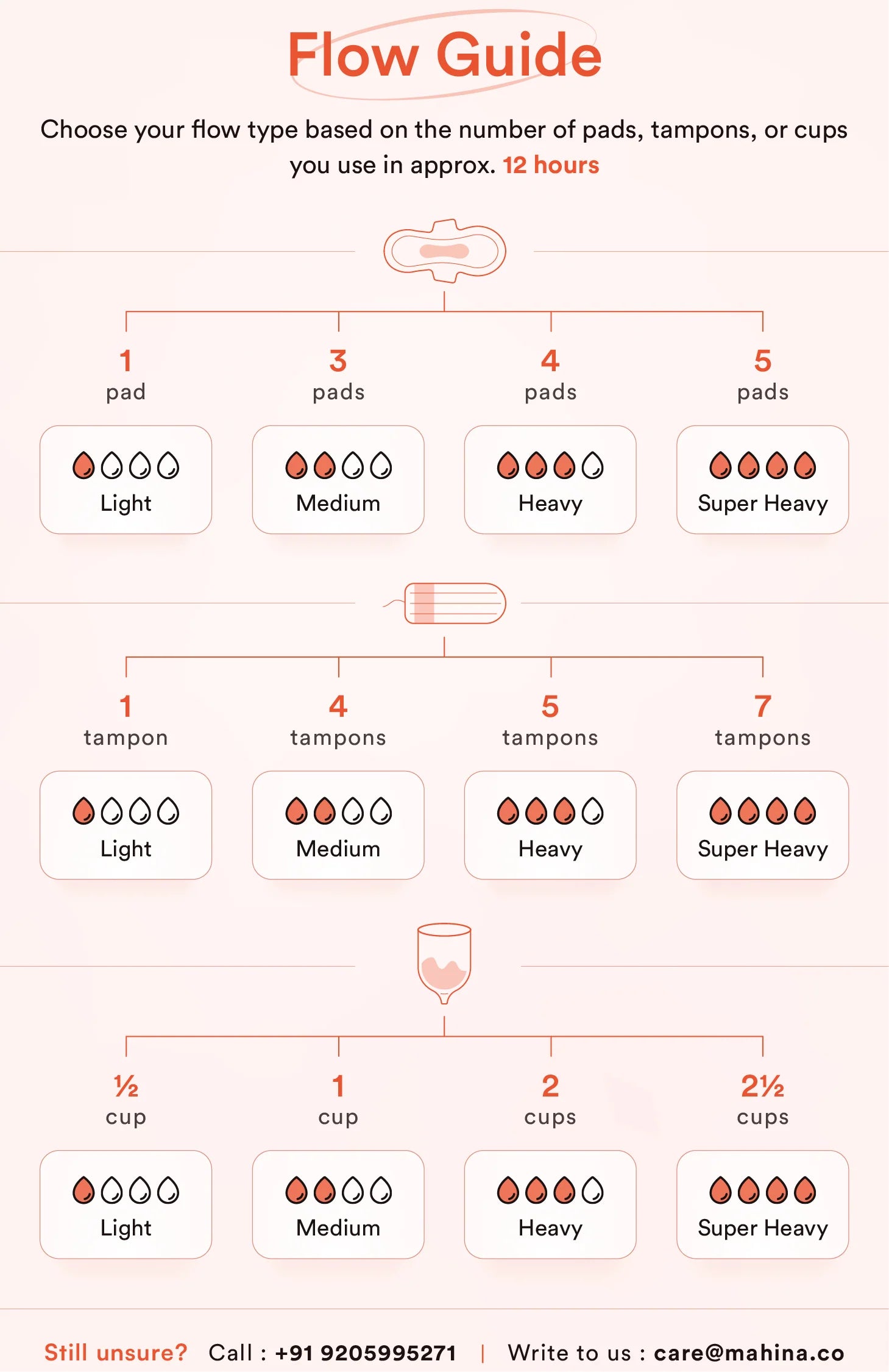
Mahina's flow guide is based on how many pads you use in approximately 12 hours — here's how that maps to the number of pairs you need:
3 pads used in 12 hours (Medium): Go for 3 to 4 pairs, with at least one medium or heavy absorbency option for your heavier days.
4 pads used in 12 hours (Heavy): A set of 4 to 5 pairs, with higher-absorbency options for peak days and overnight.
5 pads used in 12 hours (Super Heavy): Build a set of 5 to 7 pairs to see you through your heaviest days comfortably.
8 pads used in 12 hours (Super Heavy Plus): This is where the Mahina DeepSleep Period PantyTM comes in. Engineered specifically for sleep and rest, it holds up to 80ml — the equivalent of 8 pads in 12 hours. If overnight leaks have been your biggest period problem, this is what it was designed for.
If you're new to reusable period panties, starting with 2 pairs and trying them on lighter days is the lowest-risk way to test whether the switch works for you. Or, opt for the DeepSleep period panty at night, and you can feel the change in quality of sleep yourself. Once you're confident, adding 2 to 3 more pairs gets you to a full rotation.
The more pairs you invest in upfront, the faster your cost per use drops — and the longer your existing pairs last, since each one goes through fewer wash cycles.
Over three years, the numbers tell a clear story. On disposable pads, you're spending ₹5,000 every single year — ₹15,000 by the time year three is done. Switch to reusable period panties, and your entire outlay is ₹3,000 to ₹5,000 in year one. Years two and three cost you close to nothing. That's a saving of ₹10,000 to ₹12,000 over the same period — and that's assuming pad prices don't rise, which they will. With proper care, your sustainable period products will last the full three years, making every rupee of that saving real.
Where To Start
If you've been comparing options and doing the maths, the calculus is straightforward: the longer you wait, the more you spend on disposables before the switch.
Starting at just ₹749 per pair, with a lifetime of 100 wash cycles, Mahina's period panty is one of the most cost-efficient sustainable period products available in India. It's a low-barrier starting point — and once you've broken even (which happens fast), every cycle after that is money saved.
If you're a heavy or super heavy flow user, the Mahina DeepSleep Period Panty at ₹1,249 is worth adding to your rotation. With 150 wash cycles and 80ml capacity, it's designed for overnight and high-flow days when disposables are at their most expensive and least reliable.
If you're ready to build a full rotation, Mahina's period panty packs make it easier to get there in one go. Buying as a pack saves you 10% on a 3-pack, 15% on a 5-pack, and 20% on a 7-pack — which means the more you invest upfront, the faster you break even.
Start with one or two pairs if you want to try first. Check the maths at the end of your first three cycles. The savings are real. So is the comfort of not thinking about pad changes.
To Sum It Up
Switching from disposable pads to reusable period panties can lead to substantial cost savings while also simplifying menstrual care. Disposable pads require frequent changes, accumulate quickly, and create ongoing expenses over time, along with environmental impact. Reusable period panties, such as Mahina’s range, offer multiple absorbency levels and are built to last for 100–150 washes, providing protection across light, heavy, and overnight flows. A small upfront investment pays for itself in just a few cycles, with cumulative savings reaching over ₹10,000 in three years. Beyond cost, reusable panties reduce the mental load of constant monitoring, offer reliable protection throughout the day, and combine hygiene, comfort, and sustainability. Starting with one or two pairs is sufficient to test the fit, while a full rotation ensures minimal mid-cycle interruptions and maximised long-term value.

Sources
- The Economic Times: Sanitary pads take 250-800 years to decompose, which is pushing young indians to opt for greener alternatives
- Mahina: Build Your Pack
About The Author