

Key Takeaways
- There is no single medical cutoff in millilitres that separates a light, medium and heavy period on any given day.
- Doctors classify flow using total blood loss across a full cycle: under 5 ml is considered light, roughly 30–40 ml is average, and over 80 ml is the research threshold for heavy menstrual bleeding.
- Clinicians often use a scoring tool called the PBAC (Pictorial Blood Loss Assessment Chart) rather than a pad count, since pad size and habits vary too much for a fixed number to work.
- Mahina uses the number of period products you typically use over 12 hours, a practical proxy, to help match you to an absorbency.
- Medium Absorbency holds 25 ml, Heavy holds 40 ml, Super Heavy holds 50 ml and Super Heavy Plus in DeepSleep holds 80 ml.
- Changing a pad or tampon every 1–2 hours, bleeding for more than 7 days or passing large clots are signs of heavy menstrual bleeding worth discussing with a healthcare professional.
If you are trying to work out how to know your period flow type, whether light, medium or heavy, start with what actually happens during your period rather than guessing from labels. Look at how often you need protection, how quickly it fills, and whether your flow changes across the day or across your cycle.
What Is Period Flow And What's 'Normal'?
Period flow is the amount of menstrual fluid you pass during your period, and there is no single flow level that is "normal" for everyone.
Menstrual flow varies between people and can change across different days of the same period. Cleveland Clinic notes that some variation in flow from one cycle to the next is normal, while a major change from your usual pattern is worth paying attention to.
Doctors do not usually expect you to measure your menstrual blood loss in millilitres at home. ACOG notes that measuring exact blood loss has limited practical use, since most people cannot accurately do it outside a lab setting. That is why your usual product use and bleeding pattern is a more practical way to understand your flow day to day.
How To Tell If Your Flow Is Light, Medium Or Heavy
Medicine does not define light, medium and heavy flow by a fixed daily pad count or millilitre number. What clinical research does define is total blood loss across a full cycle. According to research-based thresholds, blood loss under around 5 ml per cycle is generally considered light, average total loss sits around 30–40 ml, and blood loss over 80 ml per cycle is the threshold used to define heavy menstrual bleeding.
Because collecting and measuring blood loss at home isn't practical, clinicians typically use the Pictorial Blood Loss Assessment Chart (PBAC) instead. It scores each pad, tampon or clot by how soaked or large it is, and adds the scores up across your period. A total score of 100 or more is the standard clinical cutoff for heavy menstrual bleeding, and it correlates reasonably well with the 80 ml lab threshold.
This is useful context, but it isn't something you need to calculate yourself. For everyday product choice, the more practical version of this idea is simply tracking how much period protection you use.
The Pad/Panty Test: How Many Do You Use In 12 Hours?
Instead of counting completely soaked pads across an entire day, look at what you typically need over a consistent 12-hour window.
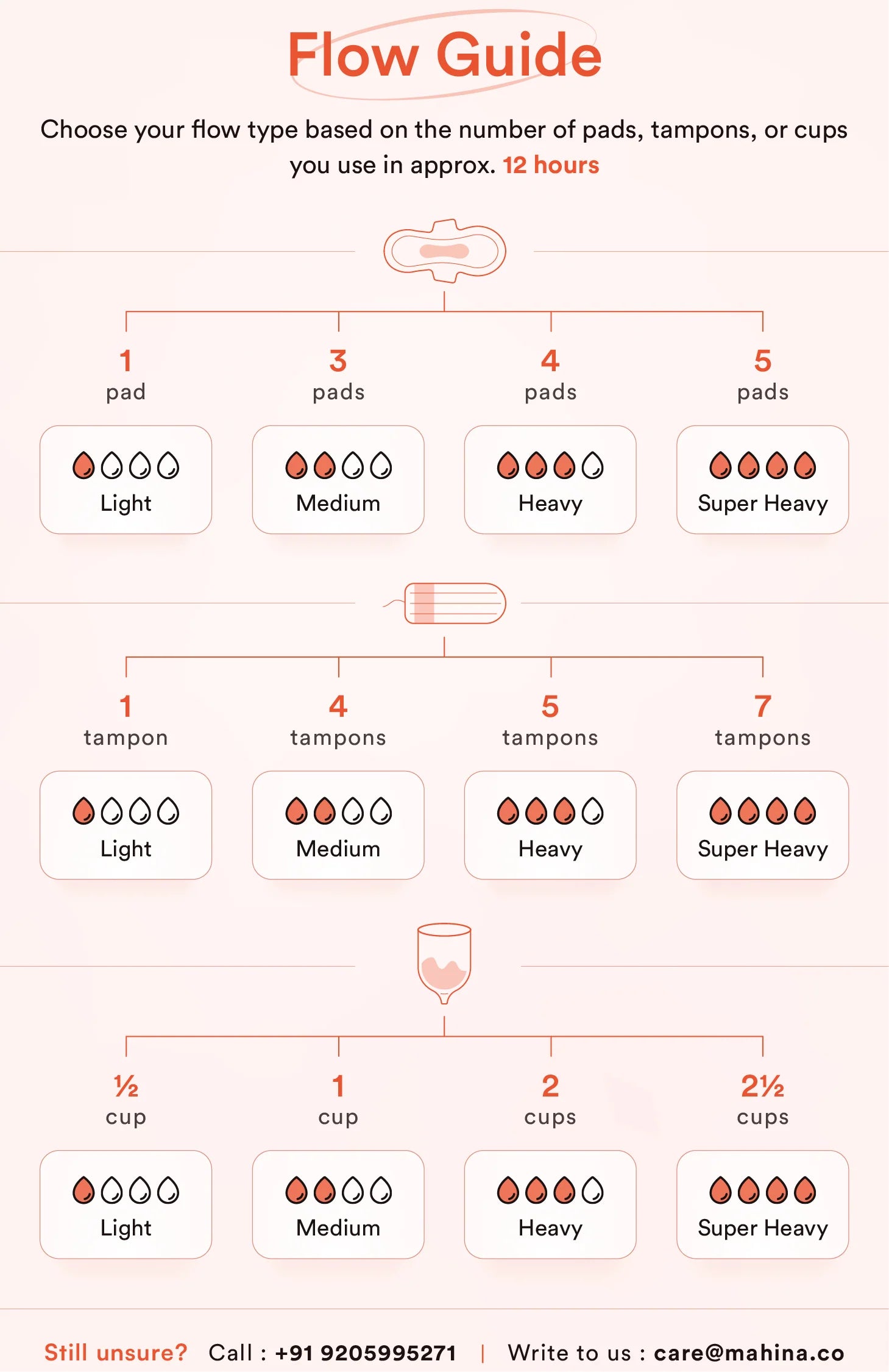
Mahina's Know Your Flow Quiz uses the number of pads, tampons or menstrual cups you typically use over 12 hours to recommend an absorbency level.
|
If you typically use in 12 hours |
Your flow may be |
What that may look like |
Mahina option |
|
Very light protection for spotting or end-of-period staining |
Light |
A few spots, stains or very low-volume flow |
Daily Panty Liner Underwear for spotting and light wetness |
|
Around 3 pads, 4 tampons or 1 cup |
Medium |
Steady flow without very frequent changes |
Medium Absorbency, 25 ml |
|
Around 4 pads, 5 tampons or 2 cups |
Heavy |
Heavier flow that needs more absorbency |
Heavy Absorbency, 40 ml |
|
Around 5 pads, 7 tampons or 2.5 cups |
Super Heavy |
Your product use increases noticeably on your heaviest days |
Super Heavy Absorbency, 50 ml |
|
Around 8 pads |
Super Heavy Plus |
You need more capacity than the Super Heavy level provides |
Super Heavy Plus Absorbency in DeepSleep, 80 ml |
These are Mahina's product-selection references, not medical definitions of menstrual bleeding.
What Does A Light Flow Look Like?
A light period usually involves a small amount of bleeding and may appear as light staining, spotting or a thin coating of blood, rather than quickly filling your period protection. Light days commonly happen at the start or end of a period.
For very low-volume days, Mahina Daily Panty Liner Underwear is designed for lighter everyday needs rather than higher-volume active flow. It absorbs up to 15 ml and replaces around 4 disposable panty liners in one wear.
If your period has suddenly become much lighter than what is normal for you, that is a different question. A noticeable change in your usual flow is worth monitoring and may need medical advice depending on the circumstances.
What Does A Medium Flow Period Look Like?
A medium or moderate flow is generally a steady flow that needs regular protection but does not involve soaking through pads or tampons every hour or two. As with "light" and "heavy", "medium" is a practical description rather than a formal diagnosis with one universal threshold.
Mahina Period Panty in Medium Absorbency holds 25 ml and is built for someone who typically uses about 3 pads, 4 tampons, or 1 menstrual cup over 12 hours.
What Does A Heavy Flow Look Like?
A heavier flow means you need more absorbency than on your regular-flow days, but there is an important difference between choosing a heavy-labelled period product and medically having heavy menstrual bleeding.
When choosing a Mahina for your flow, use your usual period-product use as a guide. If you use around 4 pads, 5 tampons or 2 menstrual cups in 12 hours, opt for Heavy Absorbency, which holds 40 ml. If you use around 5 pads, 7 tampons or 2.5 cups, opt for Super Heavy Absorbency, which holds 50 ml.
When Heavy Flow Needs Medical Attention
Medically, heavy menstrual bleeding may include:
- Changing a pad or tampon every 1–2 hours.
- Bleeding for more than 7 days.
- Passing clots larger than around 2.5 cm.
- Bleeding through clothes or bedding.
- Needing to use 2 types of period protection together.
- Periods interfering with normal activities.
- Feeling unusually tired or short of breath.
These signs are listed by both the NHS and the CDC. If they sound familiar, higher-absorbency period protection may help you manage the bleeding, but it cannot explain why it is happening. For product guidance specifically, read Mahina's guide to choosing the right period panty for heavy flow.
How Mahina Gauges Different Flow Levels
Mahina's absorbency ladder is built around how much protection you actually go through in 12 hours, since that's a number you can track yourself without lab equipment or a PBAC chart.
Each level is calibrated to hold a specific volume, matched against roughly how many pads, tampons or cups that translates to over 12 hours:
- Medium holds 25 ml and can replace around 3 pads, 4 tampons or 1 menstrual cup.
- Heavy holds 40 ml and can replace around 4 pads, 5 tampons or 2 menstrual cups.
- Super Heavy holds 50 ml and can replace around 5 pads, 7 tampons or 2.5 menstrual cups.
- Super Heavy Plus, available in DeepSleep, holds 80 ml and can replace around 8 pads per wear, making it suitable for overnight use or your heaviest days.
The ladder exists so you can choose based on how often you're actually changing protection, not by trying to self-diagnose what "too heavy" is.
How Many Pads A Day Is Normal For Each Flow?
There is no medically accepted number of pads per day that universally defines light, medium or heavy flow. Pad sizes and absorbencies differ, and some people change pads before they are full for hygiene or comfort.
Regardless of how soaked a pad is, it should still be changed regularly. The CDC recommends changing sanitary pads every few hours, even on light-flow days, and more frequently when your flow is heavy. Cleveland Clinic similarly advises changing a pad when it feels damp or at least every 4–6 hours during the day.
So, pad count alone is not the best way to define your flow. How quickly you soak through protection, how long your period lasts and whether your bleeding affects daily life are more useful indicators.
Your Flow Can Change Across Your Period
You do not need to assign yourself one flow label for your entire cycle. One day may be medium, the next heavy or very heavy, and the final days may be light enough for minimal protection. Your product choice can change with those shifts, which is why knowing your flow is less about labelling yourself as a singular flow type and more about recognising what your body needs on each day.
When Should You See A Doctor About A Very Heavy Or Very Light Flow?
The signs to watch for depend on which direction your flow has shifted. If you're regularly seeing the signs listed above under heavy flow, especially soaking through protection every 1–2 hours or bleeding past 7 days, that's a reason to see a doctor.
On the lighter end, a period that has become noticeably thinner than usual, without an obvious cause such as starting contraception, is also worth flagging, particularly alongside missed periods or spotting between cycles.
A few triggers apply regardless of direction: bleeding or spotting between periods, a sudden and unexplained shift from your normal pattern, or persistent tiredness, weakness or breathlessness during your period, since heavy blood loss over time can contribute to iron-deficiency anaemia.
If your main concern is specifically that your period has become lighter, read Mahina's dedicated guide on why periods can become lighter, rather than trying to diagnose the cause from this flow-identification guide.
Know Your Flow, Then Choose Your Protection
There's no single millilitre number that sorts every period into light, medium or heavy. Doctors work off total cycle blood loss and tools like the PBAC score; day-to-day, tracking how much protection you actually use is the practical version of the same idea, and it's exactly what Mahina's absorbency system above is built on.
If your flow pattern changes suddenly, or you're regularly seeing the signs of heavy or unusually light bleeding covered above, that's worth a conversation with a doctor, not just a product upgrade.
If you're still unsure where you land, the Know Your Flow Quiz uses your actual 12-hour product use across your cycle to recommend the right absorbency.

Sources
- NCBI Bookshelf: Physiology, menstrual cycle
- HKMJ: Validation of a pictorial blood loss assessment chart
- NHS: Heavy periods
- CDC: About heavy menstrual bleeding
- ACOG: Menstruation in girls and adolescents
- Cleveland Clinic: Menstrual cycle
- Mahina: Know Your Flow quiz
- Mahina: Your guide to the best period panties for heavy flow
- Mahina: DeepSleep overnight period panty
- Mahina: Daily Panty Liner Underwear collection
About The Author